- Please wait...
Debt: treat it like a sharp tool. Useful in the right hands, dangerous in the wrong ones.
Compound interest: the multiplier. Use it to grow savings but not debt.
Tax: The government takes at least a slice of nearly everything you earn, and this increases when you earn more.
Assets versus liabilities: assets put money into your life, liabilities take it out.
Credit rating: your financial reputation. Start building it early.
Borrowing to buy things that lose value the moment you have them – clothes, takeaways, games – on credit. You may end up paying interest on something that is already gone.
Before any purchase, work out the cost in hours worked, not pounds spent. Don’t forget to add a bit of extra time to account for the tax!
Never borrow for more than a short while to pay for something you are going to eat, wear, or play. Only borrow for things that make you richer over time.
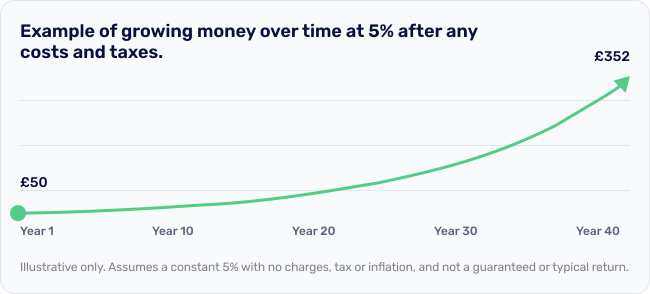
£50 at 5% earns £2.50 in year one. In year two, you earn interest on £52.50. Over 40 years, that small snowball becomes a serious sum.
A credit card at 25% interest roughly doubles an unpaid balance every three years.
Time is the real advantage here. Starting to save at 16 is worth far more than starting at 30, even for smaller amounts.
Once you earn over £12,570 a year, the government takes 20% of every extra pound. This increases as you earn more.
Roughly another 8%, funding the NHS, state pensions and benefits.
This is the “hidden tax.” 20% of the final price you pay for trainers or iPhone goes straight to the government.
less roughly 20%*
Closer to what lands in your account
When you see a gross salary – say, £36,000 – remember quite a chunk of the £3000 will be taken out before it hits your current account every month. How much depends on your earnings and your circumstances. Your favourite AI companion can help you figure out how much your take-home might be.
An asset puts money into your life: a savings account, a house deposit, investments such as shares.
*the value of investments can fall as well as rise. As with all investing your capital is at risk.
A liability takes money out of your life: a car, a phone contract, a streaming subscription, a debt or loan of any kind.
Focus on buying assets first. It is easy to spend on things that look impressive but quietly cost more than they are worth, such as a car with high running costs.
Prove you pay back what you owe, so you can get a phone contract, a car, or a flat later.
Register on the electoral roll. It is the simplest way to show up in the system.
If you get a credit card, choose one with a small limit and set up a Direct Debit to pay the balance in full each month.
At 18, a credit card with a small limit, and a Direct Debit to pay the balance in full each month, can help build your rating. Missing payments can damage it.
It also takes deliberate action from both sides:
This page provides general educational information only. It does not constitute personal financial advice or a recommendation to take, or avoid, any financial product or course of action. Tax rules and allowances are correct for the [2026/27] tax year and may change.
Sources:
[1] The London Foundation for Banking & Finance (LFBF), ‘Young Persons’ Money Index 2025–2026′ (2025) <https://www.lfbf.org.uk/research-report/young-persons-money-index-2025-2026/\> [accessed 7 October 2026]