- Please wait...
Autumn Budget 2026 explained:
what it means for your family's wealth

Read time: 6 minutes
'Forget the headlines. For one family we modelled, reacting to the rumours cost twice as much as the Budget itself.’
For weeks before John Healey’s first Budget, families were told that capital gains tax would soar, pension tax-free cash would be cut and inheritance tax would be replaced by a levy on estates. Every story urged them to act before it was too late. None of it happened.
Rumours change behaviour. In 2024-25, when speculation about tax-free cash was rife, the number of people taking pension cash for the first time without advice rose by 17 percent, according to the FCA. Among those taking advice, the number fell.
So here is what did change, what it means for a real family balance sheet, and why most families have time to review their plans calmly.
What the Budget changed
For most wealthy families, the impact is surprisingly modest.
The main rates of capital gains tax remain the same. So do the rates and allowances for inheritance tax, and pension tax-free cash.
The change that will affect most families received far less attention. From April 2027, tax on income from savings and property rises by a further two percentage points, on top of the rise announced last year. By then, interest and rent will be taxed at four percentage points more than today. For a family with large cash deposits or rental property held outside ISAs and pensions, every £10,000 of taxable interest or rental profit will cost £400 a year more in tax than it does now. The change takes effect in April 2027. It is a reason to review how assets are held, not to rush into selling them.
Two other changes particularly affect business owners. Both also start in April 2027.
A new founders’ relief. Qualifying founders of high-growth, innovative companies will pay capital gains tax at 10 percent on up to £10 million of lifetime gains. Compared with the 24 percent higher rate, that could save a qualifying founder up to £1.4 million. But who qualifies won’t be clear until the government has consulted on the details.
A smaller relief for other business sellers. The lifetime limit for Business Asset Disposal Relief, which taxes qualifying business sales at 18 percent, halves from £1 million to £500,000. The most a higher-rate taxpayer can lose is £30,000. The government says three in four claimants will be unaffected.

‘Many of our clients built businesses. Increasingly, their children want to start businesses of their own. A better deal for founders is welcome, though the details are still being consulted on. For families, the bigger question is a personal one. How do you back a son or daughter who wants to build something? Getting that right matters as much as any tax rule.’– Stuart Cash, Chief executive, Y TREE
A smaller relief for other business sellers. The lifetime limit for Business Asset Disposal Relief, which taxes qualifying business sales at 18 percent, halves from £1 million to £500,000. The most a higher-rate taxpayer can lose is £30,000. The government says three in four claimants will be unaffected.
What it means for a real family
Y TREE’s modelling team tested the Budget on an illustrative family. Pippa, 44, and Philip, 45, are high earners with two children at private school. They have a £1 million taxable investment account, pensions, ISAs and a buy-to-let property. Philip owns 20 percent of a company he expects to sell in five years.
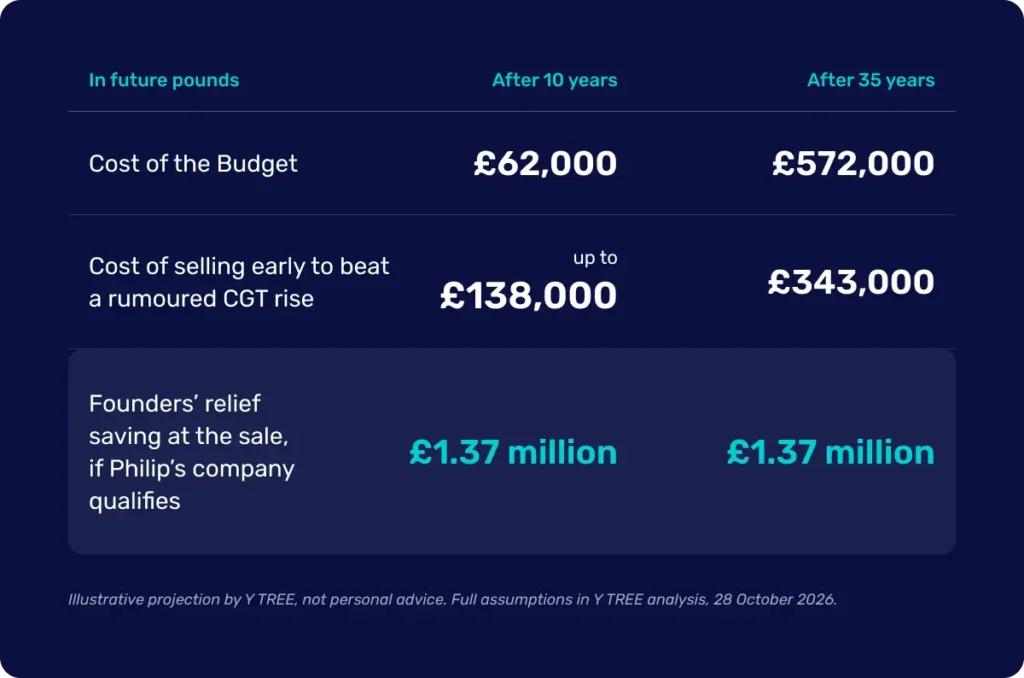
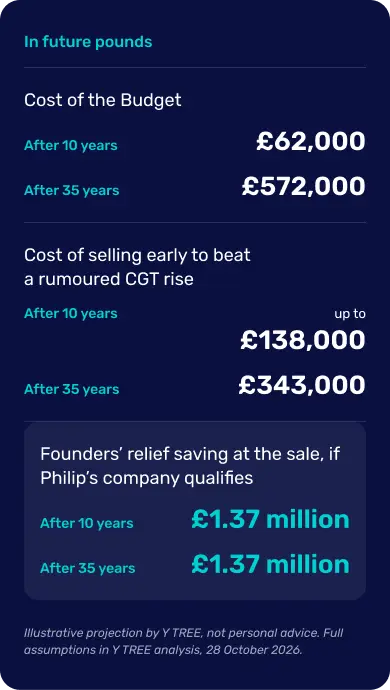
Over the next decade, the Budget costs them about £62,000. Over 35 years, the cost rises to £572,000, mainly because the proceeds of Philip’s sale will sit in a taxable account. If Philip’s company qualifies for founders’ relief, however, he saves £1.37 million when he sells.
But the most striking finding is not about the Budget at all. Acting on a pre-Budget rumour would have cost this family more than twice as much over ten years as the Budget itself.
The rumours that didn't come true
The modelling also tested a common response to the rumours. Expecting capital gains tax to rise, Pippa and Philip sell their investments and immediately buy them backThat crystallises their £400,000 gain, so they pay £95,000 in tax now, at today’s rate, to avoid a possibly higher rate later. The rate doesn’t rise and the £95,000 is no longer invested and growing. Over ten years, that decision costs them up to £138,000, more than twice what the Budget itself costs them. Even if the rate had risen, it would only have paid off if they sold within seven years.
Pension tax-free cash was rumoured to be cut in both 2024 and 2025, and survived both times. This year it survived again.
And sometimes even a confirmed change never arrives. Last year’s cut to the cash ISA allowance was announced and given a start date. Today it was scrapped before it took effect.
The bigger bill: care
For many families, the biggest question is who pays for care in later life. The Budget confirmed the government’s plans. From April 2030, the state pension triple lock will be adjusted so that the pension tracks earnings over time, and the savings will help fund a National Care Service in England, with personal care free at the point of use. In Y TREE’s modelling, the pension change alone costs Pippa and Philip £155,000 over 35 years. Free personal care is planned for the next Parliament, and the details will wait for the independent commission on adult social care, which now reports in 2027.
Personal care is also only part of the cost. Accommodation in a care home is a separate bill. So families should not assume the state will meet their care costs. This is one change worth reviewing long-term plans for, even before the detail is settled.
Where this leaves families
Anyone selling a business in the next year or two, or holding large sums in taxable savings or rental property, should take advice before the changes start in April 2027. Anything that depends on detail still to come, such as founders’ relief and the National Care Service, can wait. And a rumour alone is no reason to make a costly decision.
Even the Office for Budget Responsibility says much better and much worse outcomes are about equally likely. A sensible plan allows for both.
As Stuart Cash puts it: ‘Every Budget brings a fresh round of noise. Government decisions do matter, and some families will need to adjust. But a good plan is built for tax changes, market falls and the things nobody saw coming. It should absorb a Budget like this one without being rewritten.’
As with all investing, capital at risk.
Sources
Financial Conduct Authority. (2025, 16 September). Retirement income market data 2024/25. Financial Conduct Authority.
HM Treasury. (2025, 26 November). Budget 2025. HM Treasury.
HM Treasury. (2026, 28 October). Budget 2026. HM Treasury.
Office for Budget Responsibility. (2026, 28 October). Economic and fiscal outlook: October 2026. Office for Budget Responsibility.
Y TREE. (2026, 28 October). What the Budget means for Pippa and Philip [Unpublished modelling]. Y TREE.
About the author
Robin Powell
Robin Powell is a financial author and consumer advocate and is a columnist for The Times and MoneyWeek
