- Please wait...
AI spending and US shares: what has changed?

Read time: 6 mins
Has the Artificial Intelligence (AI) boom gone too far? Are US tech stock prices and the vast sums being spent on AI justified? These are some of the questions our clients have been asking lately. Having answered these for clients, we thought we’d share our perspective more widely.
We don’t subscribe to “predicting” which way the market will move, so our focus isn’t on whether this is a bubble or the next big investment opportunity. Instead, we’ve looked at what has actually changed underneath the headlines.
The starting point is that a lot of optimism is already built into today’s prices. Buying US shares at these levels assumes that the AI spending pays off and that the enormous sums the big technology companies are investing turn into real revenue and profit over the coming years. That’s what these prices reflect. So two questions are worth asking: How are the companies paying for it? And is there evidence that it is working?
What's changed in the AI sector?
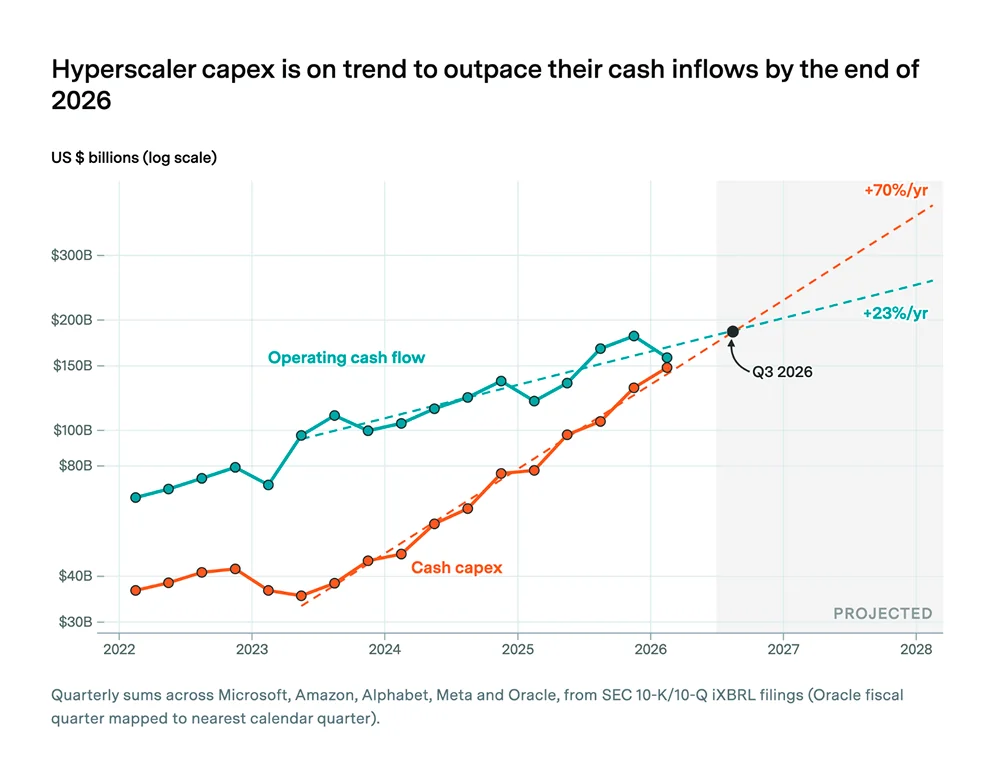
On funding, something has genuinely changed. Until recently, the largest technology companies paid for this build-out entirely from their own cash. They generated so much of it that they didn’t need to borrow. This is why the AI technological build-out looks more stable compared to the dot-com era, when debt undid companies whose returns came too slowly. It is different now. Spending runs close to 100% of the cash these companies generate, against roughly 40% a few years ago, and future guidance points even higher. So their cash flow no longer covers it, and they’ve started borrowing, and issuing shares, to fund the gap. Nothing is broken, and none of these companies is in immediate trouble. But it’s a real change: a company that funds itself is in a stronger spot than one that now needs to borrow in the market.
Is AI adding value?
On the second question, there is a good reason why investors are still willing to fund these companies: the technology is working. A recent BCG study[2] of 107 large technology companies, grouped by how heavily they actually use AI, found that the heaviest users grew revenue by around 16.5% over the year, compared with roughly 5% for the lightest users. The broader earnings backdrop has also been highly supportive: blended second-quarter earnings for US companies in the S&P 500 are running 47.4% above the same period last year, primarily driven by unusually large gains reported by Alphabet and Amazon. While these findings suggest correlation rather than direct causation, it is a genuinely encouraging sign that the spending is beginning to translate into real commercial results.
There is also an important distinction between today’s investment cycle and periods when valuations were driven largely by expectation alone. Many of the companies leading AI investment are already highly profitable, generate substantial cash flows and have the balance-sheet strength to fund this spending internally. That does not remove the risk of overinvestment, nor does it guarantee that every dollar of capital expenditure will earn an attractive return. But it does mean that the current enthusiasm is being supported by businesses with real earnings power, rather than by a purely speculative promise of future growth.
The open question is therefore not whether AI is creating value at all, but whether it will create enough value, quickly enough, to justify the extraordinary amount of capital now being committed.
Is your portfolio too concentrated in the US?
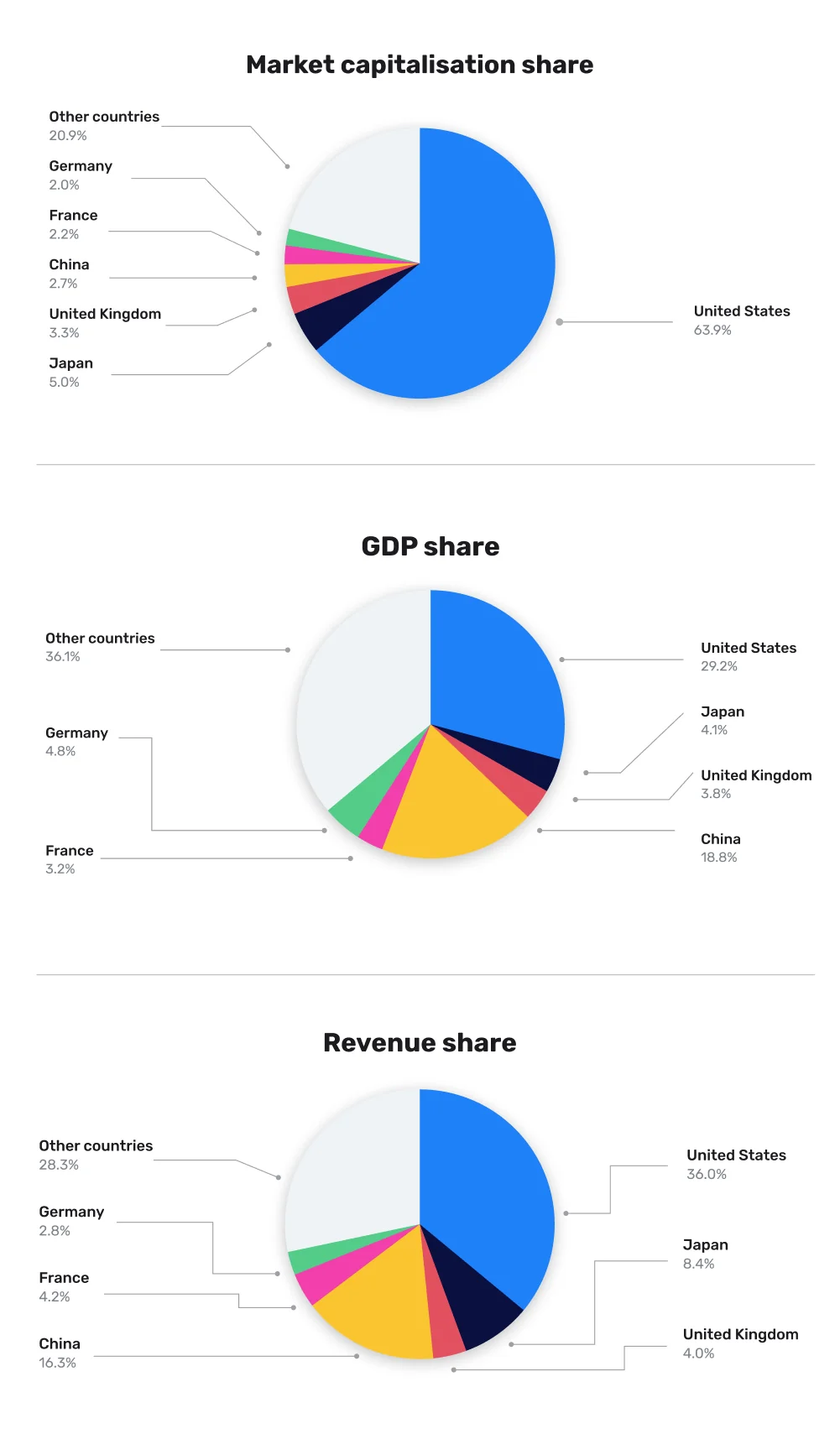
These AI-leading tech giants carry such immense market valuations, raising valid questions about portfolio concentration. Equity market capitalisation is not representative of economic significance. At first glance, global equity markets look heavily concentrated in the US. Roughly two-thirds of the MSCI ACWI index is made up of US-listed companies. But market capitalisation is only one way of looking at the global economy. Where a company is listed, and how highly the market values it, is not the same as where it generates its revenues or where economic activity takes place.
Viewed through those different lenses, the picture is more balanced. While the US represents roughly two-thirds of the index by market capitalisation, its share of global economic output and company revenues is closer to one-third. This highlights both the considerable economic importance of activity outside the US and the strength of the US financial environment, where deep capital markets, a concentration of globally dominant companies and strong investor demand support a much larger share of global equity market value.
That distinction is important, but it does not mean today’s level of market concentration is without consequence. A relatively small number of very large US technology companies now account for a greater share of the global index than they did a few years ago. As those companies have grown in weight, the risk characteristics of the market itself have changed.
The answer isn’t reducing US exposure significantly, or removing it altogether. As this can introduce substantial risks of its own. Many of the world’s leading technology companies, and some of its most innovative and profitable businesses, are concentrated in the US. Moving away from the market entirely could therefore mean giving up exposure to important long-term sources of growth and diversification.
Y TREE’s approach
So, what does this mean in practice? The market as a whole carries more risk than it did a few years ago. It’s worth understanding that this underlying shift in the market can bring changes to a portfolio.
Our response to clients is deliberate, tailored to their specific needs and their life goals, and, importantly, for shifting markets, also their risk level.
When underlying markets move, a portfolio can drift away from the risk level that was chosen. That is why we monitor each client portfolio daily and rebalance it back to target when needed, which helps most when markets are falling. At points of market stress, investors can be tempted to make irrational decisions just when discipline is most important. Our technology, which has been designed with an institutional investor mindset, means our clients don’t have to make these decisions.
It’s about building a financial life strategy, designed to withstand market stress, that ensures each client’s life plans remain achievable while staying within their capacity for risk.
So what can we conclude from this analysis? The market environment has become a little riskier. The answer to a riskier environment isn’t to react to headlines; It’s to have a plan that has decided what is needed irrespective of the headlines.
Sources
- Juniewicz, I. (2026), ‘Hyperscaler capex is on trend to outpace their cash inflows by the end of 2026’, Epoch AI, 16 June 2026.
- Kropp, M., Bedard, J., O’Niell, C., Duranton, S. and Hsu, M. (2026), The Era of Token-Based Competition Is Here. Is Your AI Strategy Ready?, Boston Consulting Group.
- Katiyar, S. and Gupta, A. (2026), ‘Economic Weighting: An Alternative Approach to Country Allocation’, MSCI, 16 July 2026. Market-cap data as at 31 July 2026 based on MSCI ACWI index; GDP data from the IMF World Economic Outlook (April 2026); revenue share based on aggregate reported revenues of index constituents.
This communication is for general information only. It reflects our current view of markets and does not constitute personal advice or a personal recommendation, and does not take account of your individual circumstances. Please speak to your adviser before making any decision. Our views may change.
As with all investing, your capital is at risk. The value of investments can go down as well as up and you may get back less than you invested. Past performance is not a reliable indicator of future performance.
